The Thousand Brains Project being open-source means not only that we open-source our code, but also that, as much as we can, we open-source our processes and planning. To that effect, I wanted to share with you my current view of the Monty platform, in the form of Platform Current Reality Tree.
What is a Current Reality Tree?
Definition
A Current Reality Tree (CRT) is a logical structure designed to depict the state of reality as it currently exists in a given system. It reflects the most probable chain of cause and effect, given a specific, fixed set of circumstances. (…) It’s functional rather than organizational, blind to arbitrary internal and external system boundaries.[1]
Purpose
- Provide the basis for understanding complex systems.
- Articulate undesirable effects (UDEs) exhibited by a system.
- Relate UDEs through a logical chain of cause and effect to critical causes.
- Identify the critical causes that produce a majority of the system’s UDEs, including the worst ones.
- Isolate those few causal factors – system constraints – that must be addressed in order to realize the maximum improvement of the system.
- Identify the simplest potential changes that will have the greatest positive impact on the system.[2]
How to read a Current Reality Tree?

Read the tree in the direction of the arrow. Each arrow points from a cause to an effect. Each part of the tree can be verbalized in sentence. For example, with the arrow point from entity (I turn off the light.) to an entity (The room is dark.), one would verbalize it as “If I turn off the light, then the room is dark.”
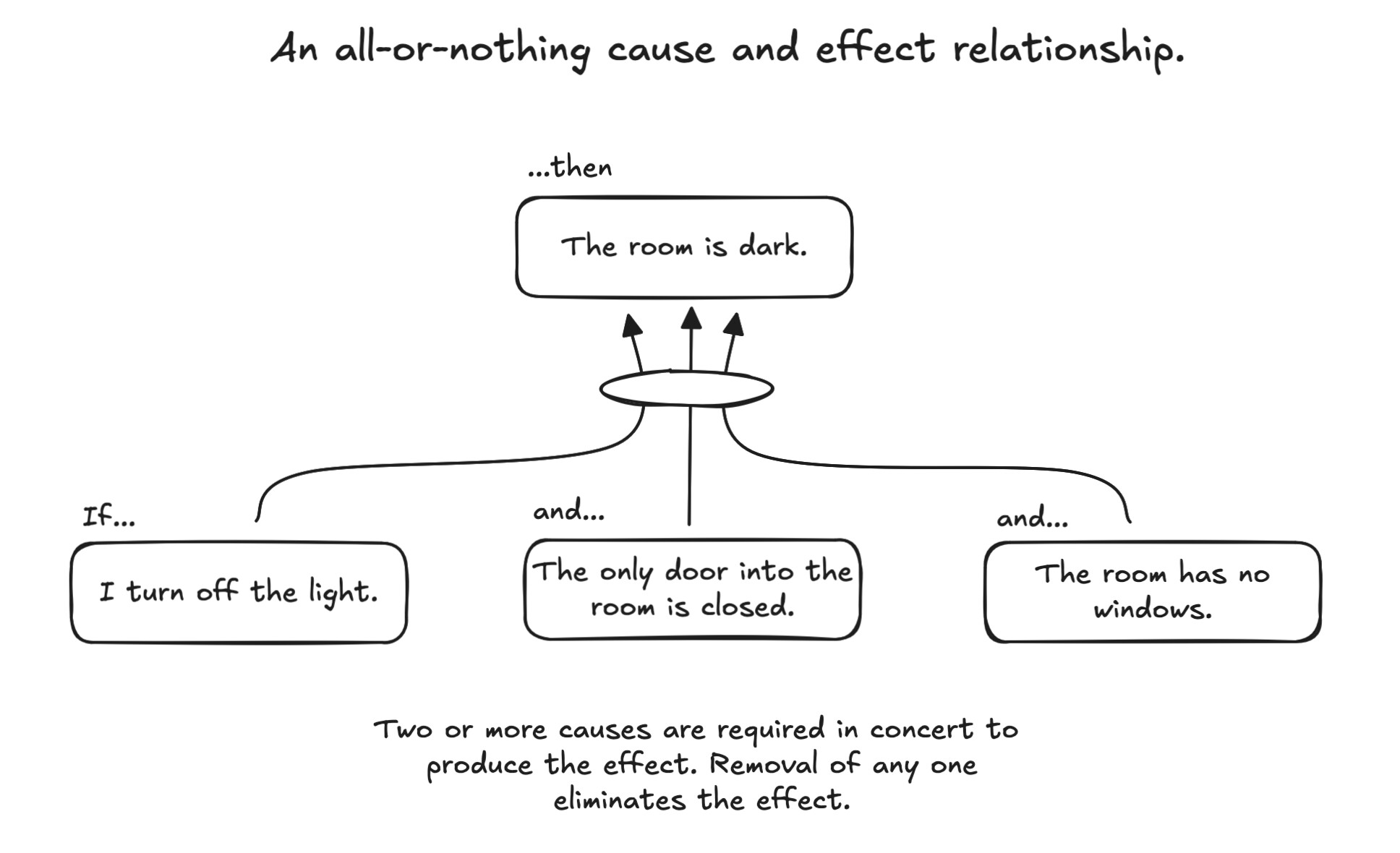
A round oval over the arrows means that all the causes are required to have the desired effect, an all-or-nothing cause and effect relationship. For example, with three entities on the bottom row (I turn off the light.), (The only door into the room is closed.), (The room has no windows.) all with arrows pointing to the entity (The room is dark), where those arrows are under a round oval, would be verbalized as “If I turn off the light, and the only door into the room is closed, and the room has no windows, then the room is dark.”

A MAG symbol over the arrows means that there is a magnitudinal cause and effect relationship between the causes and the effect. The causes independently produce the effect with some magnitude. Removal of any one eliminates some (not all) of the effect.

When arrows are indepent of each other, this implies independent cause and effect relationships. Each cause independently causes the effect and both must be removed to eliminate the effect.
The entire Platform Current Reality Tree is quite large to take in all at once. Below is a (collapsed) list of all the Undesirable Effects listed in the tree.
Undesirable Effects as of 4 Sep, 2025
- 271 Monty users are unclear about how to use Monty in different applications.
- 272 We don’t know if tutorials break when tbp.monty code changes.
- 273 Tests in tbp.monty/tests/unit are slow.
- 276 Platform is not integrated with a simulator that runs on Windows.
- 277 Platform requires unsupported Python 3.8.
- 279 Platform is distributed via conda.
- 278 Monty cannot be installed from PyPi via pip install tbp.monty.
- 239 Multiple components control the motor system.
- 109 Platform motor system and policies are entangled with the environment, data loader, and dataset.
- 242 Some people conceptualize the Platform as Deep Learning instead of Reinforcement Learning.
- 144 Configuring the Platform is complex.
- 108 Customizing Dataloader and Dataset for new environments is complex.
- 137 To use the Platform outside of tbp.monty repo requires configuration and run boilerplate.
- 110 Platform main loop is more complex than necessary.
- 152 Experimental framing is hardcoded into the Platform.
- 245 Platform main loop requires iteration by an external controller.
- 116 Platfrom detailed logging explodes memory.
- 103 Platform internal representations are difficult to visualize.
- 104 Platform logging is not sufficiently configurable.
- 134 Platform adds preconfigured logging handlers by default.
- 135 Platform logging is unstructured.
- 245 Platform main loop requires iteration by an external controller.
- 250 Platform uses two quaternion conventions (WXYZ and XYZW).
- 106 Monty system, Experiment, and Environment are all coupled together.
- 374 Implementing the Cortical Message Protocol (CMP) requires understanding of how tbp.monty works.
- 379 Implementing the Cortical Message Protocol (CMP) is toilsome.
- 118 I have to split one sensor state into two that use .depth and .rgba suffixes.
- 122 Inconsistent naming convention between configuration and use in code of learning module and sensor module names.
- 121 Module ID initialization is inconsistent between the sensor and learning modules.
- 212 Platform can’t control most robots.
- 207 We do not clearly understand how Monty should interact with multiple end-effectors.
- 251 Platform uses untyped dictionaries for the majority of data.
- 112 Coordinate system transforms are challenging to reimplement.
- 117 Platform has no legible performance profiling or metrics (e.g., wall-clock duration, CPU load, GPU load, memory load, network load, etc.).
- 100 I can’t provide a custom noise regime for sensor modules.
- 381 Platform API is unstable.
- 113 Platform is available only on x86_64 architecture.
- 115 Most experiment episodes take more than 1 second to execute.
- 371 Updating published benchmarks is toilsome.
- 402 MontyForGraphMatching can be configured with an incompatible policy.
- 120 BasePolicy is not compatible with MontyForGraphMatching model.
To find each one on the tree, press CTRL+F (or CMD+F) to open the search menu, and search for the entity text. You can then click on the search result to be taken to that portion of the tree.

Another way to conceptualize the Platform Current Reality Tree is that it is in the “problem space.” Ideally, you will see no solutions listed. This is one of the benefits of a Current Reality Tree, in that it allows us to focus on what is causing the problems without overindexing on the first solution that comes to mind.
How can you contribute?
The Current Reality Tree is intended to highlight existing, factual, cause and effect relationships. If you feel something is not a fact, if you feel the cause and effect relationship does not make sense, if you feel an Undesirable Effect exists but is not present, let us know.
I’m not sure of the best format yet. You can start by responding to this post and we’ll figure it out over time.
What’s next?
With the Platform Current Reality Tree in its initial iteration, next up I’ll be sharing a Platform Future Reality Tree. That’s where we will swap Undesirable Effects for Desired Effects, and figure out what actions we need to take to make the future reality happen. These actions will highlight some specific contribution opportunities to move the platform forward and some of them may expand into project plans (Prerequisite Trees).
For a small example of how Current Reality Tree + Future Reality Tree + Prerequisite Tree work together, you can take a look at Prototype: HypothesesUpdater operations on CUDA GPUs.
 .
.